Urgency of Regulation on Personal Data Potection in Indonesia
ELSAM, Jakarta – Currently we faced the situation where the data circulation can be done online, which makes it unlimited by time and space. Such situation become one challenge for the protection of citizen’s privacy rights, including personal data protection. The raising number of personal data leaking which is further being traded to the third party for business purpose and even crime has showed that the personal data protection has become a factual and real issue in Indonesia. The condition was worsened by the lack of regulation which is able to protect the personal data in order to keep the citizen’s privacy.
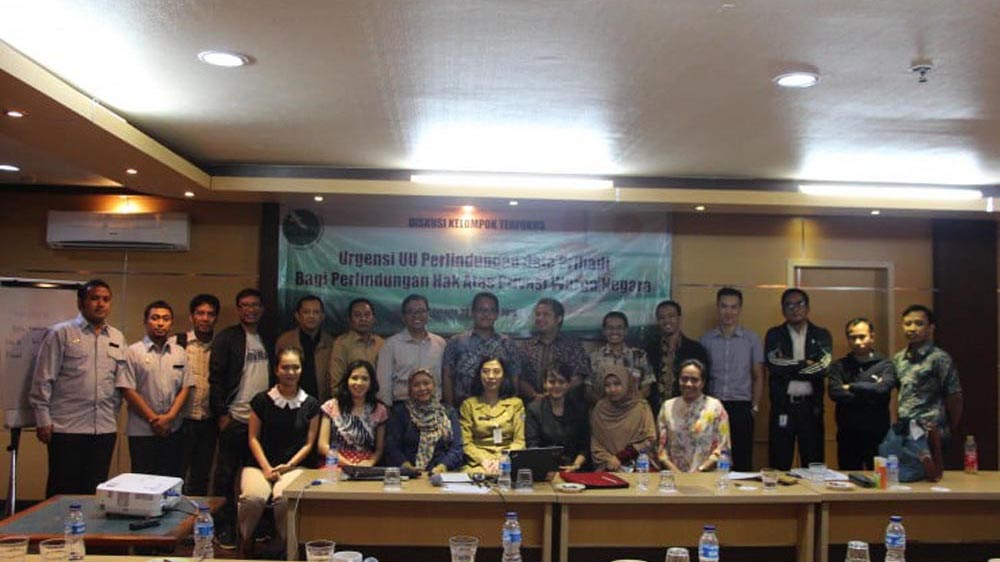
Seeing the urgency of regulating the personal data protection in Indonesia, Institute for Policy Research and Advocacy (ELSAM) held a focused group discussion, on Monday (22/2) which aimed at promoting the enactment of Law on Personal Data Protection. The participants of the discussion were from academician, Ministry of Communication and Informatics, Central Information Commission (KIP), Data and Information Center of Ministry of Health, Directorate General of Population and Civil Administration of Ministry of Home Affairs, National Development Planning Agency (Bappenas), Financial Transaction Report and Analysis Center, Secretariat General of House of Representative, a number or non-government organizations such as Yayasan Lembaga Konsumen Indonesia (YLKI), LBH Pers, ICT Watch, Indonesian Cyber Security (ISCF), as well as from the private sectors represented by MASTEL and APJII. Other than that, the discussion was expected to provide a room for the stakeholders to jointly oversee the formulation process of the regulation in order to realize the regulation on personal data protection to fulfil human rights.
Sinta Dewi Rosadi, the academician from Law Faculty of Universitas Padjajaran being the drafter of Bill on Personal Data Protection as well, conveyed that the global phenomenon, which also occurs in Indonesia today, looks at personal data as having high value to business interest. Therefore, it also causes the raising number of violations and rejection of regulation on personal data protection. In spite of that, Sinta said that the regulation targeting at giving personal data protection comprehensively gives positive impact to business. For instance, in Singapore, the acknowledgement of privacy data as a human rights which must be protected gives an impact to the increase of economy in the country because the consumers feel safe to do business transaction.
Similarly, Ismail Cawidu, the Head of Information and Public Relations Center of Ministry of Communication and Informatics (Kominfo), stated that the role to protect the privacy right of the citizen is the state obligation. According to him, if the state do not give protection, it is deemed as violating human rights. Adding to the legal basis, personal data protection also needs an institution or watchdog to implement the rules and regulations. In this regard, Cawidu proposed the Central Information Commission to add a ‘chamber’ to have the authority related to personal data or information protection with reference to the system implemented in other countries, such as England.
Responding to the discourse, Rumadi as the commissioner of Central Information Commission stated that basically the concept to regulate personal data protection is slightly different from information disclosure. In terms of information disclosure, all information principally are open, unless otherwise specified in which the access to public should be closed. It is in contrast of the privacy. However, Rumadi acknowledged that a number of cases in KIP is related to the problems of personal data. Departing from the similar urgency, Rumadi considered that it needs the radical information to the Law on KIP to add such authority.