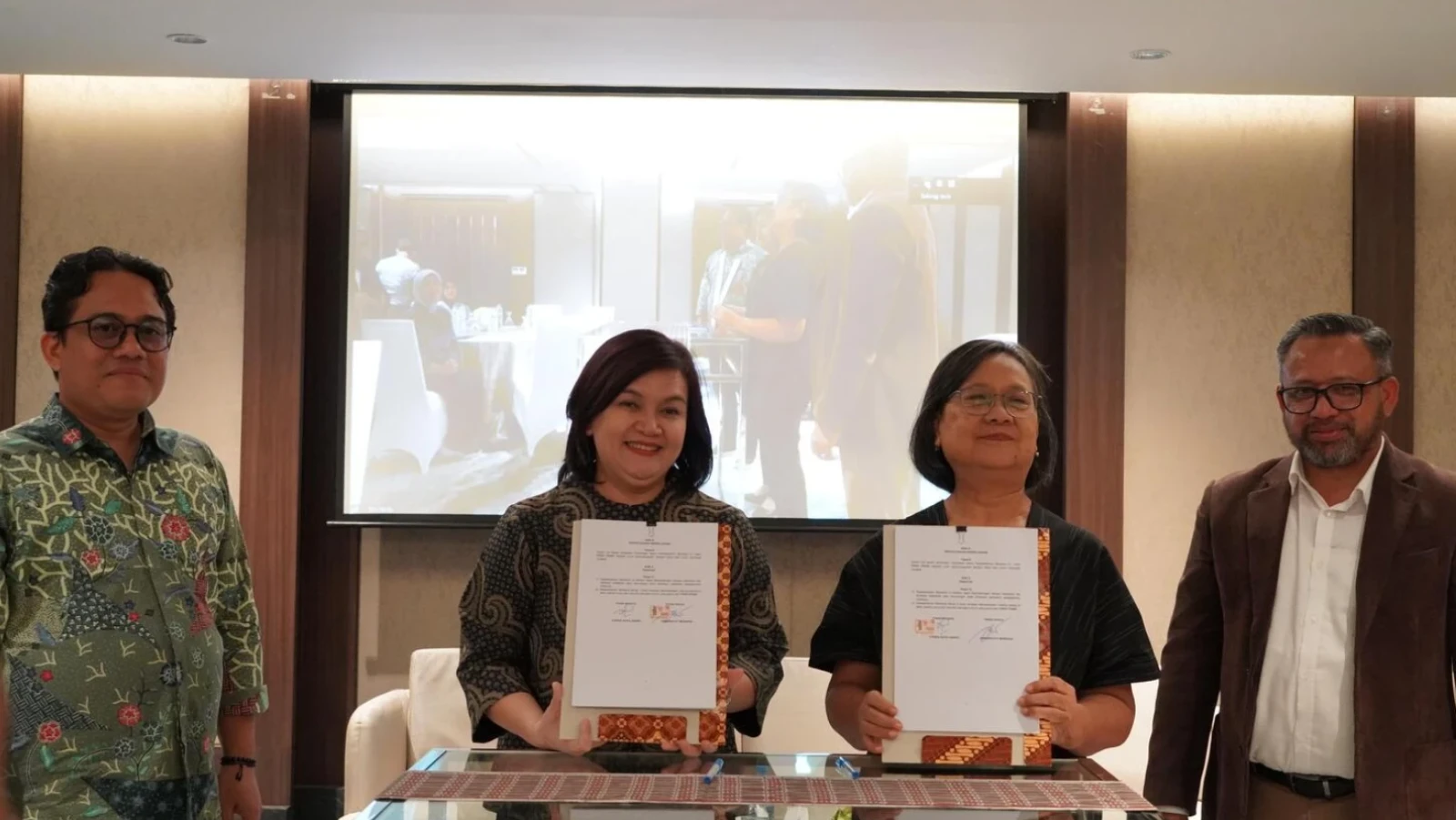
Memorandum of Understanding between ELSAM and KOMNAS HAM: Cooperation and Commitment in the Implementation of Norm and Regulation Standard (SNP) of Business and Human Rights
ELSAM and the National Commission on Human Rights (Komnas HAM) of the Republic of Indonesia signed a Memorandum of Understanding (MoU) on the implementation of Standard Norms and Regulations (SNP) No. 13 on Business and Human Rights on Monday, October 21. A public discussion entitled "The Effectiveness and Relevance of Human Rights Values in the Domination of Corporate Power" was also held.
The event began with the signing of a Memorandum of Understanding between ELSAM and Komnas HAM RI as a form of cooperation and commitment in the promotion of human rights. The Chairperson of Komnas HAM RI, Dr. Atnike Nova Sigiro, also gave a keynote speech entitled "Interpretation of the Mandate of Komnas HAM RI in Promoting and Protecting Human Rights in Response to the Dynamics of Business and Human Rights Issues".
Atnike said that the SNP on Business and Human Rights aims to provide guidance for all parties, state and non-state, including business actors, to participate in efforts to respect human rights. On the other hand, this SNP also provides guidance for civil society to understand the principles of business and human rights in their efforts to seek remedies for human rights abuses involving business actors.
The event was followed by a public discussion and presentations by five speakers on the implementation of SNP No. 13 on Business and Human Rights. "Corporations have power over human rights because through this power corporations can influence, violate, inhibit, reshape, realize, or limit the rights of individuals or groups. The effects of corporate domination result in epistemic injustices that harm victims. The concept of epistemic injustice is a useful tool for overcoming the harmful practices of corporate power. Said Adzkar Ahsinin, ELSAM's Senior Researcher on Corporate Dominance in Business and Human Rights.
Director of Human Rights Dissemination and Strengthening, Ministry of Law and Human Rights of the Republic of Indonesia, Mrs. Gusti Ayu Putu Suwardani, Bc.I.P., S.H., M.Si. shared about three ways that the government will do until 2025 in continuing business and human rights policy. These include the drafting of a Presidential Regulation on a more operational national business and human rights strategy, institutional strengthening, and human rights education for companies in Indonesia.
Ono Haryono as the Business and Human Rights Team of Komnas HAM RI also commented that there are various challenges in the implementation of SNP No. 13 on Business and Human Rights. However, in the midst of these challenges, there are strategies that can be carried out such as policy advocacy, consultation, education, monitoring and evaluation, multi-stakeholder cooperation, reporting and transparency, community empowerment and integrating the standard into the National Action Plan.
This cannot be separated from the complex challenges of implementing human rights governance in the midst of corporate dominance, including the risk that the resulting policies may become a loophole for corporations to ignore their human rights responsibilities. Komnas HAM RI has a strategic role in streamlining business and human rights norms in Indonesia, particularly in ensuring the implementation of the UN Guiding Principles, and has a role in contextualizing business and human rights norms in accordance with its mandate to promote and protect human rights, including monitoring, receiving complaints and mediating on behalf of rights holders.